You hear it every night. Footsteps crossing the kitchen, the TV going in the family room, the kids thundering down the hall, all of it landing in the basement like the ceiling isn’t even there. Or maybe it’s the other way around, and the home theater or the laundry room downstairs is bleeding sound up into the rest of the house. Either way, the fix usually starts in the same spot: the space between your basement ceiling and the floor above it. This guide covers how soundproof insulation for basement ceilings actually works, what it does for both noise and comfort, and what to think through before you insulate a basement ceiling in Loveland, CO.
Why Basement Ceilings Let So Much Noise Through
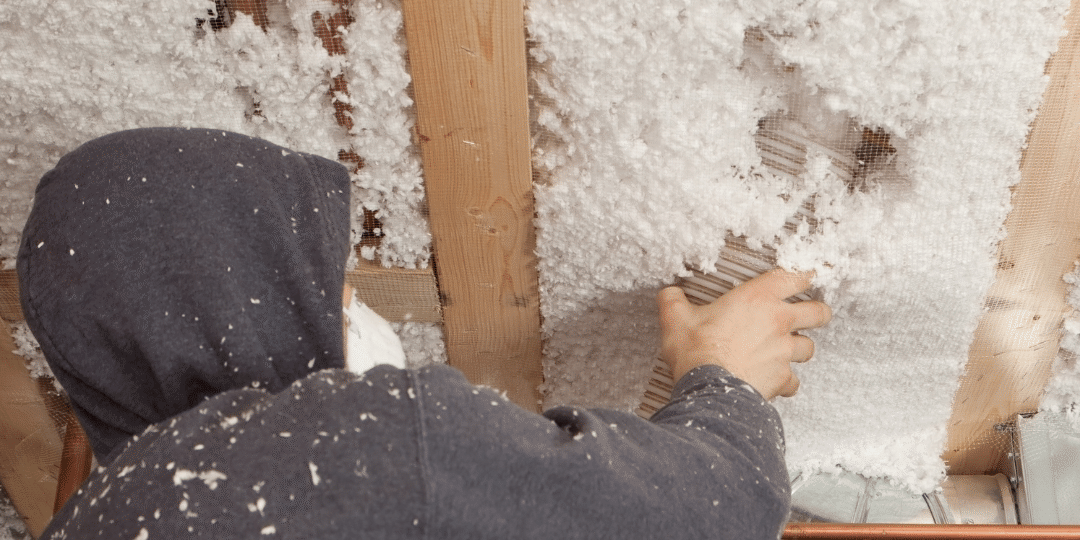
The basement ceiling is mostly hollow. Between the drywall below and the subfloor above, you’ve got a row of open joist cavities and a lot of air. Sound loves that setup. When someone walks across the floor above, the whole assembly acts a little like a drum: the framing and the two surfaces vibrate, and that vibration carries straight into the room below. An empty cavity gives sound almost nothing to push against, which is why an uninsulated basement ceiling can feel like it barely separates the two floors at all.
Filling those cavities changes the physics. Insulation adds soft, dense material where there used to be open air, and that material absorbs a big chunk of the sound energy before it ever reaches the other side.
The Two Kinds of Noise You’re Actually Fighting
Before you pick a material, it helps to know that not all noise behaves the same way.
Airborne noise is anything that travels through the air first: voices, music, a TV, a barking dog. It hits the ceiling, vibrates it, and comes through. This kind of noise insulation handles really well.
Impact noise, sometimes called structure-borne noise, is different. That’s footsteps, dropped objects, furniture scraping, a treadmill running. It travels through the framing itself, not just the air. Insulation helps with impact noise, but it can’t fully stop it on its own, because the sound is moving through the solid wood connecting both floors. That’s an honest limitation worth knowing up front, and it shapes how far you take the project.
Which Insulation Actually Helps With Sound
Not every insulation type is built for quiet. A few options do the job well:
- Mineral wool (rock wool): Dense, fire-resistant, and holds its shape in the joist bay. Its weight and stiffness make it one of the better choices for absorbing airborne sound.
- Fiberglass batts: More budget-friendly and still a solid step up from an empty cavity. They work best when they fill the bay completely with no gaps or compression.
- Blown-in cellulose: Good for getting full, even coverage in cavities that are hard to reach or oddly shaped, and it packs in tightly around obstructions.
The common thread is density and a complete fill. Sound sneaks through gaps, so a cavity that’s only half packed or full of voids won’t perform the way it should, no matter which product goes in.
Insulation Alone Won’t Do Everything
If your goal is a noticeably quieter basement, insulation is the foundation, but it’s rarely the whole answer for serious sound control. The three levers that make the biggest difference together are mass, decoupling, and sealing.
Mass means adding weight to the assembly, usually a second layer of drywall, so there’s more material for sound to fight through. Decoupling means separating the drywall from the framing with resilient channel or isolation clips, so vibration has a harder time crossing from one floor to the other. And sealing means closing the gaps that let noise slip past everything else: recessed can lights, plumbing and duct penetrations, and the rim joist around the perimeter.
That last piece is where soundproofing and everyday comfort overlap. The same gaps that let sound through also let air move, so sealing them cuts down on drafts and keeps conditioned air where it belongs. It’s the reason air sealing and insulation almost always get handled together.
The Comfort You Get Beyond Quiet
Even if noise is what pushed you to look into this, the thermal side is a real bonus. Basements tend to run cooler than the rest of the house, and without insulation in the ceiling, that cooler air pulls heat down out of your living space. Insulating the basement ceiling slows that transfer, which keeps the floors above warmer underfoot and makes a finished basement easier to hold at its own temperature instead of fighting the rooms above it.
That matters more here than in a lot of the country. Loveland winters get cold and swing hard from day to night, so anything that helps your heating system stop working overtime tends to pay off. Pair the insulation with proper air sealing and you get the quiet you were after plus a basement that’s simply more comfortable to be in year round.
A Few Things to Check Before You Insulate
Two quick things worth sorting out first. Moisture is one. Basements can be damp, and you want to handle any water issues before you close up the ceiling, since trapped moisture causes bigger problems than the noise you started with. The other is access. If your ceiling is already finished with drywall, adding insulation is more involved than doing it on an open ceiling, and it’s often worth timing the work with a remodel or a basement finish so you’re not tearing into a finished space twice.
Frequently Asked Questions (FAQs)
Not completely, and any company that promises total silence is overselling it. Insulation dramatically cuts airborne noise like voices and TV. Cutting impact noise like footsteps takes a combined approach with insulation, added mass, and decoupling.
Mineral wool is a favorite for sound because it’s dense and stays put in the cavity. Fiberglass and blown-in cellulose also help. The right pick depends on your ceiling, your budget, and how much noise you’re trying to kill.
Yes. The same material that absorbs sound also slows heat transfer between your basement and the floor above, so you get quieter rooms and steadier temperatures at the same time.
You can, but it’s more work than insulating an open ceiling. Options include blown-in insulation through access points or opening the ceiling during a remodel. It’s usually smoothest to bundle it with other basement work.
That depends on your current setup and how far you take the project. Going from an empty cavity to a full, dense fill is a clear, hear-it-right-away improvement for airborne noise. Adding mass and sealing gaps takes it further.
It’s worth it. Gaps around lights, ducts, and the rim joist let both sound and air pass through, so sealing them improves the quiet and the comfort in one step.
Ready for a Quieter, More Comfortable Basement? Talk to Insulation Pros of Colorado
If noise between your basement and the rest of the house has worn out its welcome, the fix is usually simpler than living with it. At Insulation Pros of Colorado, basement insulation and air sealing is core work, and we can look at how your ceiling is built, where sound and air are getting through, and what combination of insulation and sealing will get you the quiet and comfort you’re after. Reach out and we’ll help you put together a plan that fits your home and how you use it.